Descubrir el libro
The Cost of Being a Universe
A Deductive Foundation of Cosmology
¿Qué hace falta para que un universo tenga una historia?
Tres puertas de entrada al libro
Elija el recorrido que le convenga: cada uno abre el libro con la profundidad adecuada.
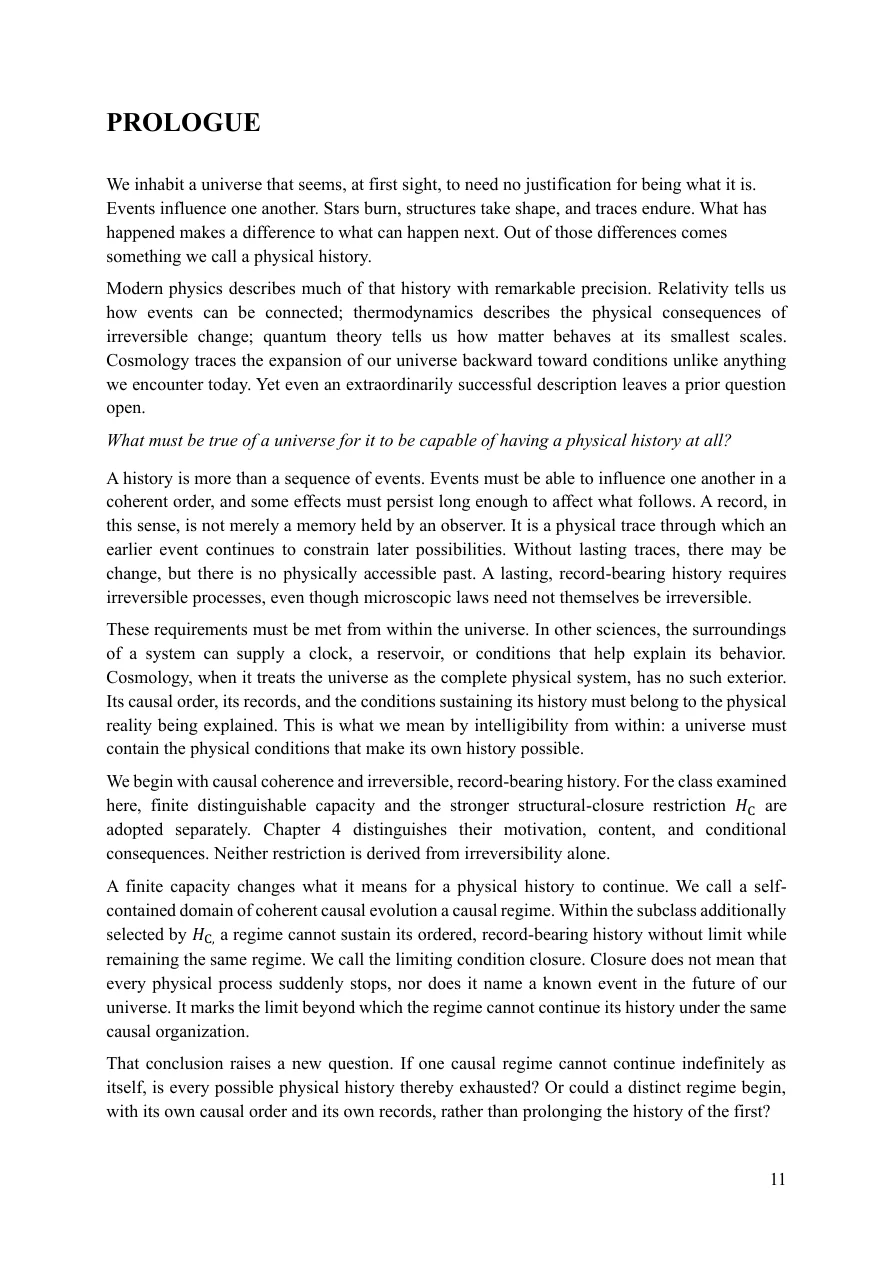
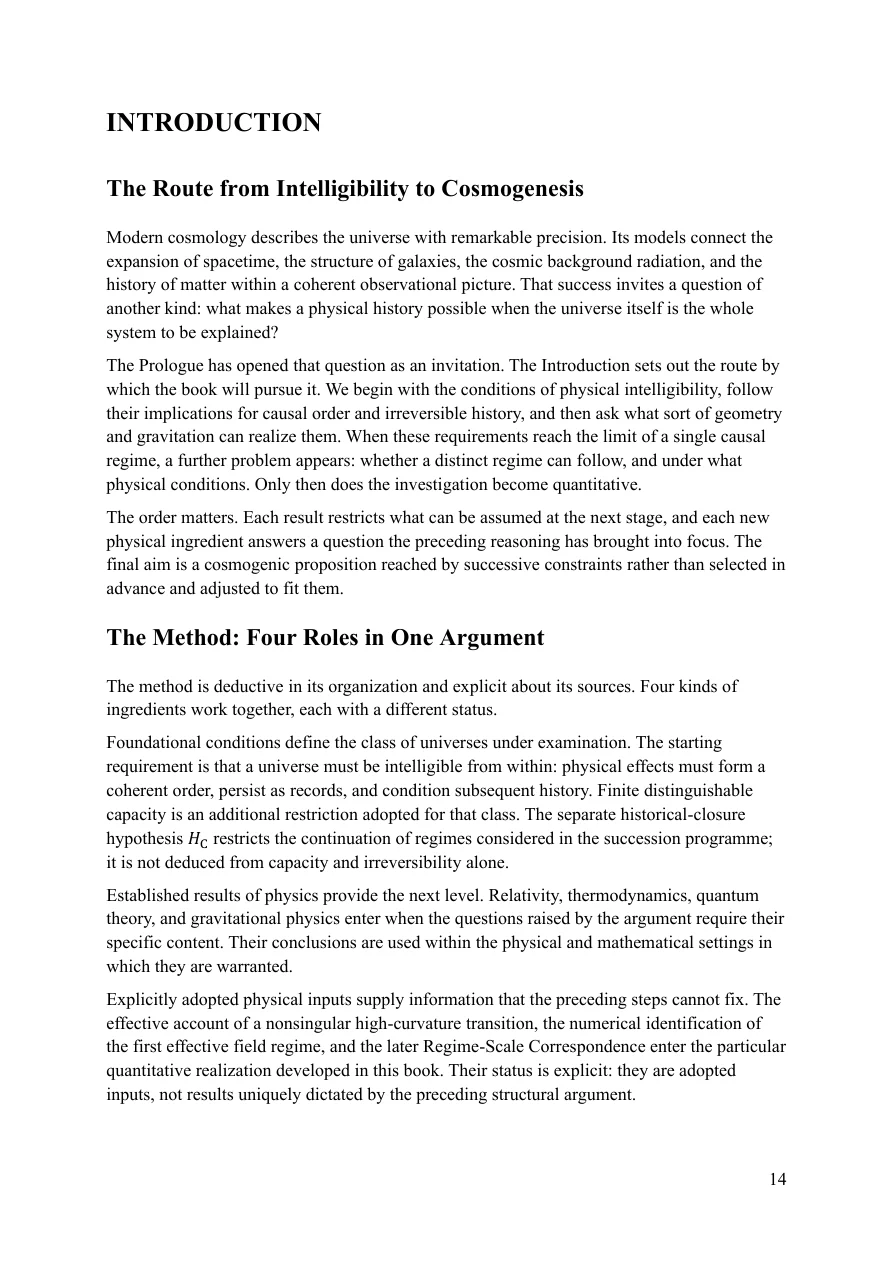
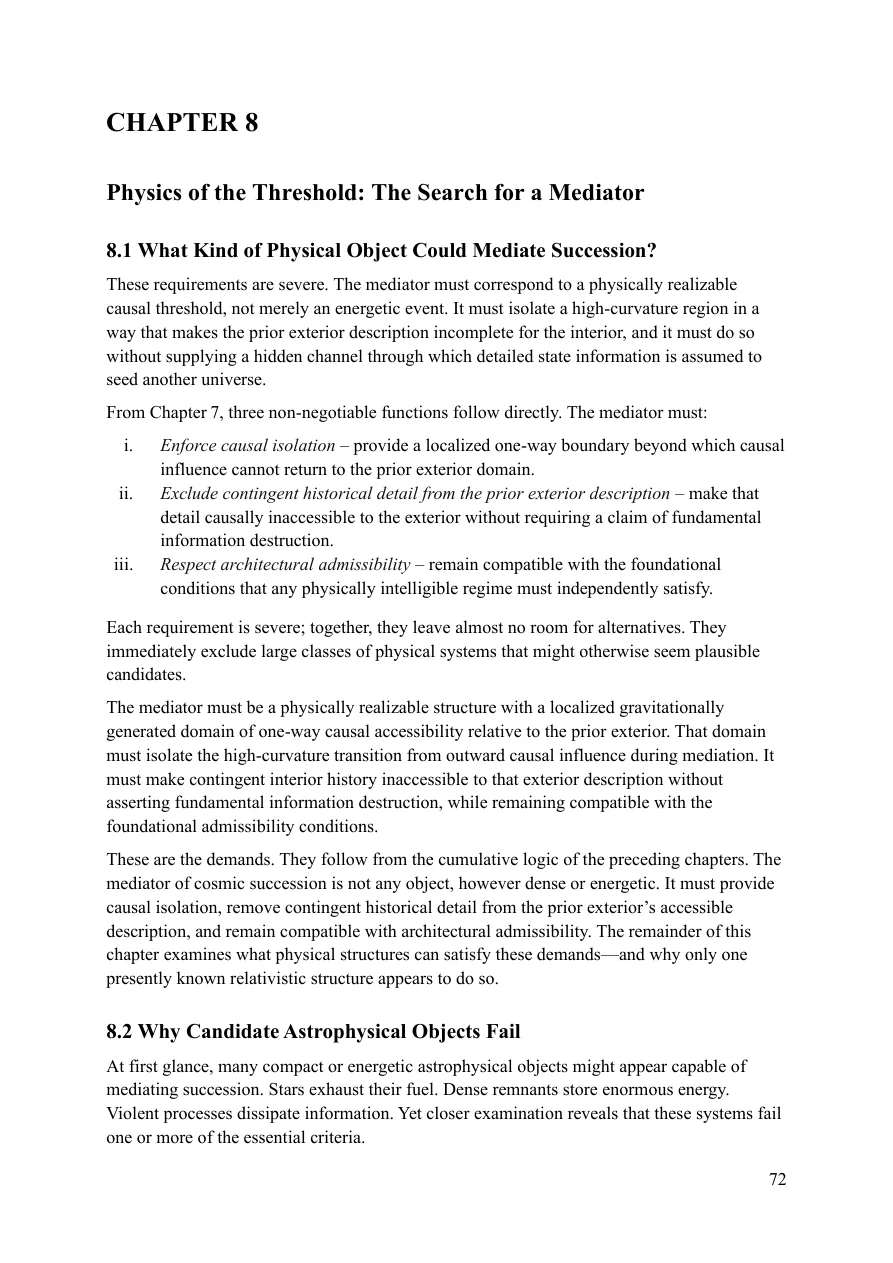
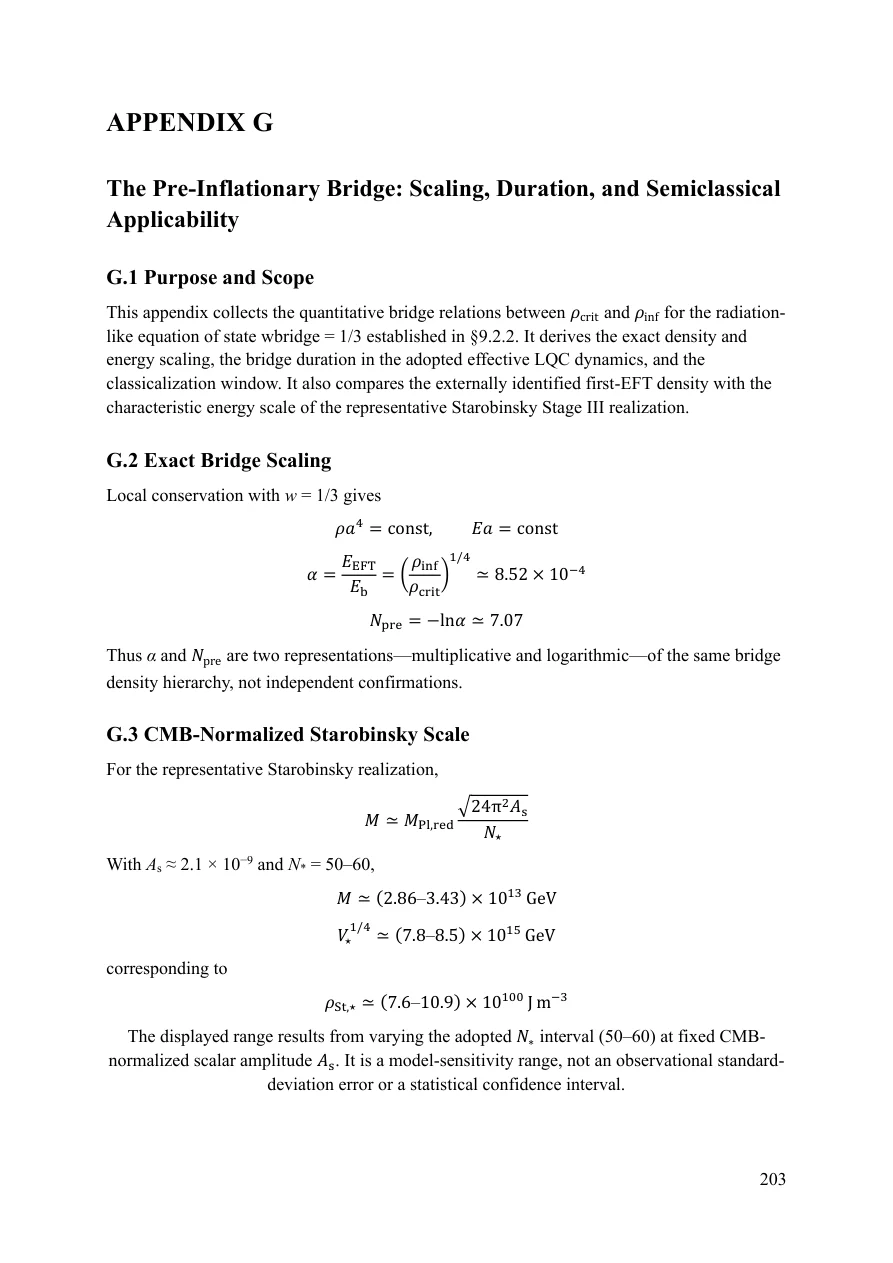
Leer las primeras páginas
Secciones completas, legibles en línea con la paginación original de la edición A4.
Publicaciones
Preprints y trabajos de investigación recientes.
- Preprint 2026
Conditional Termination Bounds in Fixed-Ratio Cosmological Succession
This paper investigates the physical conditions under which a hypothetical cosmological succession, governed by a fixed ratio between successive energy scales, must terminate after a finite number of ancestral generations. It derives explicit conditional bounds from the Kottler–Nariai horizon constraint and from the energy available for black-hole formation during a radiation-dominated cosmological phase. It also establishes a criterion for the existence of a uniform lower bound on the Hubble rate at radiation equality. A family of exact FLRW solutions with correlated initial data demonstrates why individually positive matter and vacuum contributions do not necessarily impose a uniform termination bound. The results identify the assumptions required for finite ancestry while distinguishing mathematical admissibility from physically realized cosmological succession. Neither finite nor infinite ancestry is established as a universal outcome.
Ver la ficha EN - Preprint 2026
From Intelligibility to Finite Cosmic Lineage
This preprint develops a deductive approach to cosmogenesis that asks how far cosmological structure can be constrained before a particular dynamical model is chosen. Its sole generative premise is physical intelligibility from within a universe without an external observer, reservoir, or comparison class. From this premise, it identifies requirements of causal order, persistent records, thermodynamic irreversibility, and finite usable capacity, and traces their consequences using established mathematics and physics. The central result is that physical intelligibility imposes a limitation: neither a causally complete cosmological regime nor a realized succession of such regimes can remain indefinitely open while the capacity sustaining its history is treated as unlimited and dynamically irrelevant. The resulting architecture is therefore structurally finite. A quantitative realization is subsequently developed under explicitly stated physical conditions. It yields a radiation-like bridge, a characteristic attenuation factor organizing successive cosmological scales, a formally ordered energy lattice, and a theoretically derived lower structural endpoint. The ancestral endpoint is shown to be structurally necessary but quantitatively non-identifiable from the available premises. Throughout the analysis, derived consequences, adopted physical realizations, conditional extensions, constitutive definitions, benchmarks, and genuinely open questions are kept explicitly distinct. The paper does not propose a new fundamental equation of motion; it establishes a constrained deductive architecture and identifies precisely where additional physical information becomes indispensable.
Ver la ficha EN - Preprint 2026
Causal Foundations of Relativistic Spacetime: Structural Constraints on the Emergence of Physical Geometry
This work examines why relativistic spacetime, rather than alternative causal organizations, is realized at large scales. Instead of taking Lorentzian geometry as a starting point, the paper develops a deductive framework based on minimal physical requirements for any viable universe. The analysis identifies a set of structural constraints—continuity of physical history, localization, interactional coherence, and internal generation of causal order—and shows that these jointly restrict the admissible forms of causal organization. Under these conditions, a shared finite causal bound emerges as a stable requirement, and relativistic spacetime appears as the most robust known realization of such bounded causal structure. The argument does not attempt a formal derivation of General Relativity, nor does it claim mathematical uniqueness. Rather, it establishes a structural selection principle: among known large-scale frameworks, Lorentzian causal geometry best satisfies the combined demands of physical intelligibility and dynamical coherence. Version 2: This revised version includes improved conceptual clarity, strengthened internal consistency, and minor corrections, particularly in the discussion of causal closure and interactional coherence.
Ver la ficha EN - Preprint 2026
The Cost of Becoming: Entropy, History, and Cosmological Closure
This paper develops the Principle of Closure: the claim that a universe containing genuine physical history may require global conditions under which the cumulative cost of irreversible becoming remains physically intelligible as a whole. Modern cosmology successfully describes large-scale evolution, yet physical history presupposes more than succession in time. It requires persistent traces through which prior states remain materially legible in later ones. Such traces depend upon effectively irreversible processes that consume free-energy gradients, generate entropy, and carry cumulative thermodynamic significance. A structural question then arises: if cosmology treats the universe as the total physical system, within what framework is the total cost of irreversible history to be understood? The paper argues deductively that closure is not an optional metaphysical addition, but a consequence of the demand that cumulative becoming be coherent at the scale of the whole. Without some form of closure, irreversible history remains locally describable yet globally unresolved. Situated at the intersection of cosmology, thermodynamics, general relativity, and philosophy of physics, this work proposes a foundational constraint on any theory of a history-bearing universe.
Ver la ficha EN