Scientific & academic libraries
What physical conditions make an intelligible cosmic history possible?
The Cost of Being a Universe
A Deductive Foundation of Cosmology · Ricardo G. Steinmann
Beginning with causal coherence and thermodynamic irreversibility, the book develops a deductive architecture for examining relativistic spacetime, the limits of self-contained causal regimes, and the possibility of cosmological succession. It investigates black holes as candidate mediators, a finite-curvature bounce, and conditional relations between characteristic cosmic scales.
Foundational restrictions, adopted physical inputs, conditional deductions and unresolved questions are explicitly distinguished. The physical status of finite ancestral succession remains open.
13 chapters · 16 technical appendices · 107 bibliographic entries
Reading & technical samples
The opening sections, a complete chapter on black-hole mediation and a complete technical appendix.
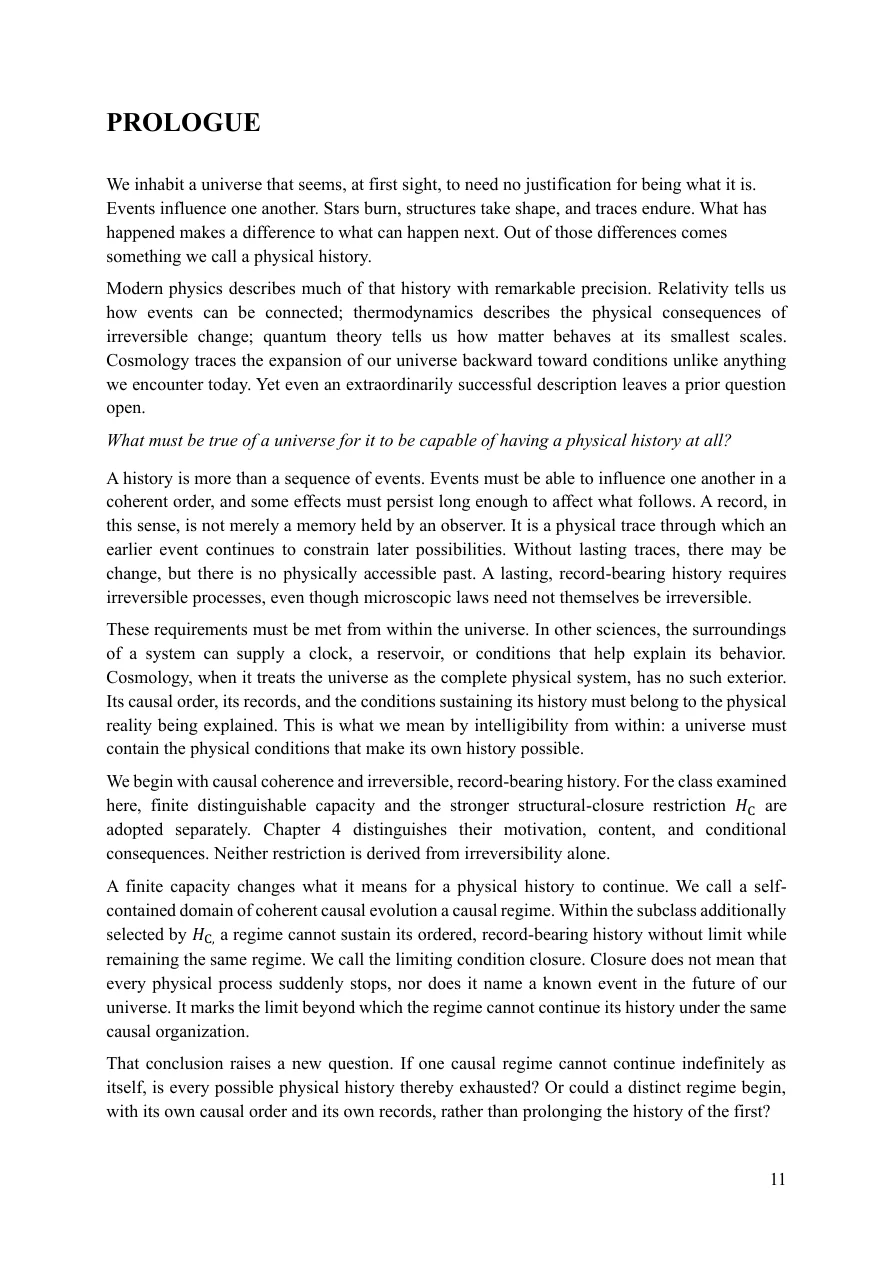 Prologue 3 pages · p. 11–13
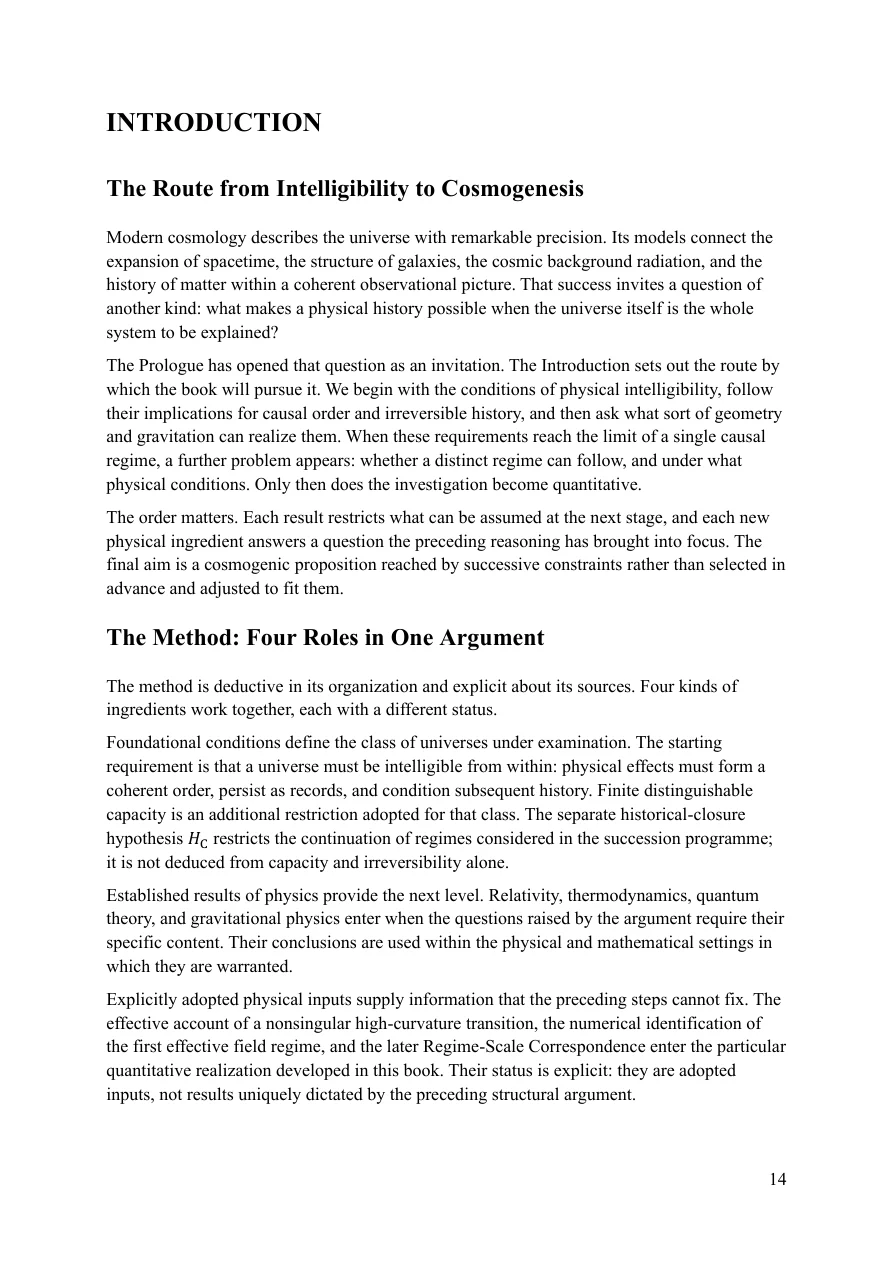 Introduction 4 pages · p. 14–17
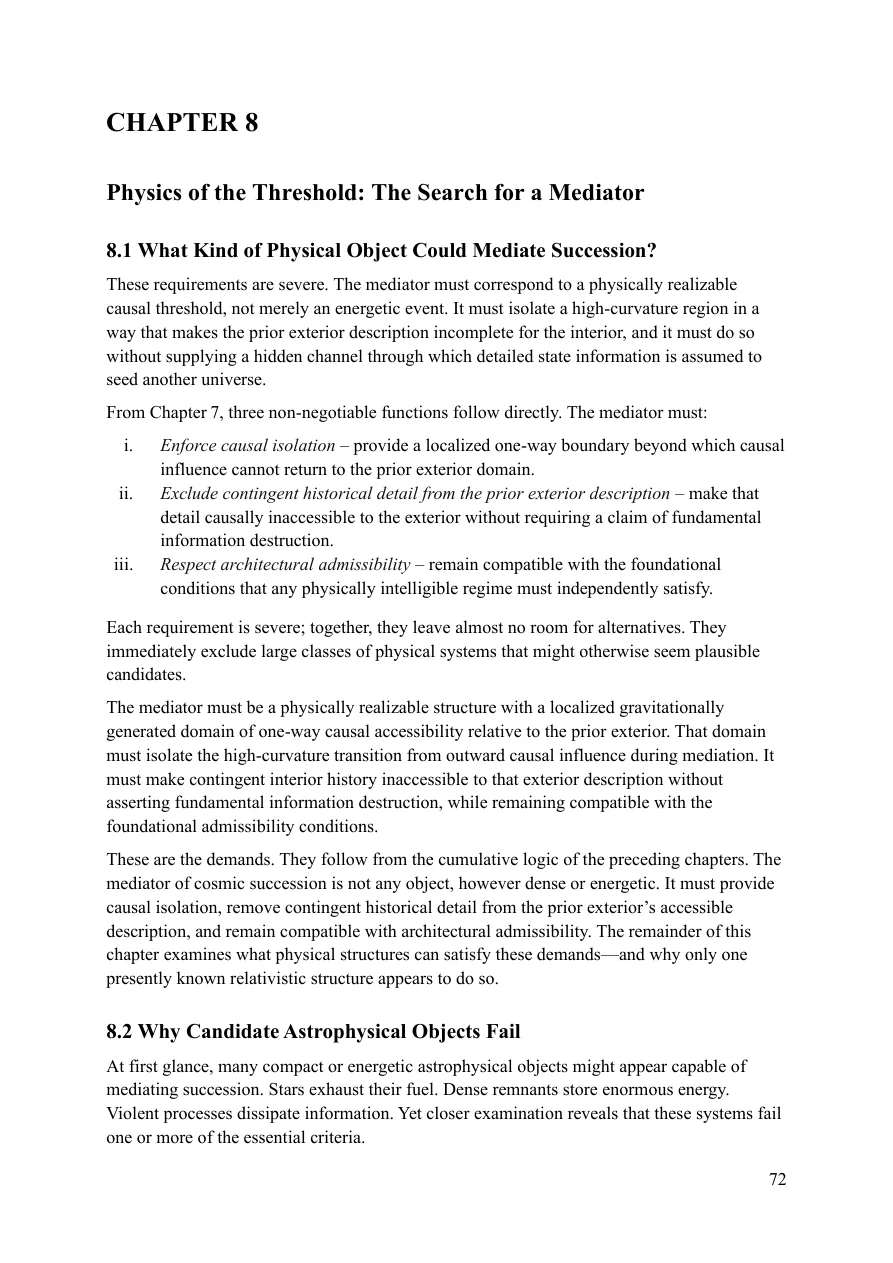 Chapter 8 — Physics of the Threshold: The Search for a Mediator 8 pages · p. 72–79
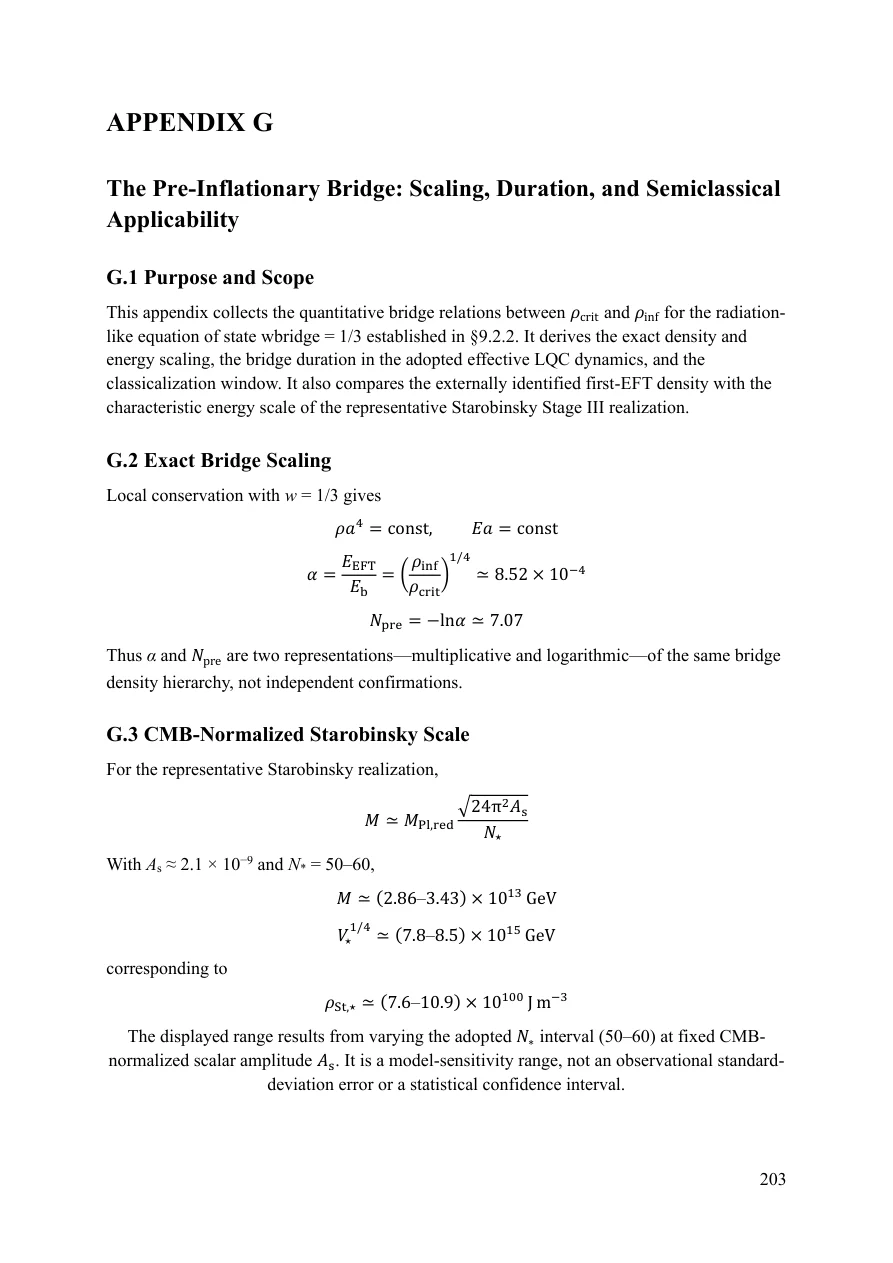 Appendix G — The Pre-Inflationary Bridge: Scaling, Duration, and Semiclassical Applicability 4 pages · p. 203–206
Read the complete sections here, without downloading. Original pagination from the A4 edition is preserved.
Table of contents
Page numbers refer to the A4 edition.
Chapters
- 1Intelligibility as a Physical Problem18
- 2Causality, Stability, and the Derivation of Relativistic Spacetime22
- 3The Cost of Becoming33
- 4Finitude as a Physical Requirement38
- 5The Dynamical Imperative: From Causal Bound to Reactive Geometry44
- 6The Economy of Becoming: General Relativity as Minimal Dynamics49
- 7The Logic of Succession: Constraints, Closure, and Independent Realization59
- 8Physics of the Threshold: The Search for a Mediator72
- 9Structural Determination of Cosmological Transition Scale80
- 10Scaling Lattice and Cosmic Succession105
- 11Structural Consistency of the Bridge and Scaling Architecture140
- 12Empirical Exposure, Conditional Signatures, and Limits of the Framework145
- 13The Deductive Architecture: Formal Scale Relations and Physical Succession152
- Conclusions160
- Epilogue164
- Conceptual Perspective166
Appendices
- AFrom Causality to Geometry174
- BThermodynamic Irreversibility and Comparative Capacity in the Cosmic Lineage179
- CBounce Dynamics, Critical Density, and Finite Curvature182
- DCausal Correlation Growth During the High-Curvature Bounce193
- EBlack-Hole Mediator Viability195
- FRobustness of the Quantitative Scaling Architecture199
- GThe Pre-Inflationary Bridge: Scaling, Duration, and Semiclassical Applicability203
- HQuantum Localization, GR-Equivalent Compactness, and the Lower Structural Bound207
- IRelativistic Matching, Global Completion, and the Open Ancestral Problem209
- JScale Separation and Structural Consistency in the Cosmic Lineage221
- KDimensionality and Thermodynamic Ordering Across Causal Regimes223
- LThermodynamic Capacity and the Structural Tail Scale228
- MConfigurational Capacity and the Accessibility of Cosmological Histories231
- NThe First-EFT Endpoint and the Conditions for Accelerated Expansion234
- OSymbols, Parameters, and Physical Quantities237
- PSynopsis of the Deductive Architecture244
- Glossary257
- References265
Book details
- Title
- The Cost of Being a Universe
- Subtitle
- A Deductive Foundation of Cosmology
- Author
- Ricardo G. Steinmann
- Language
- English
- Hardcover
- 294 pages · 8.25 × 11 in
- Paperback
- Planned
- ISBN, price and ordering
- To be confirmed